
7 Steps to Request Custom Artisanal Fabric Samples
Last Updated: October 25, 2026
Quick Summary
To request artisanal fabric samples, send a short, clear email stating your project's end use, measurements, light exposure, palette reference, and deadline, plus questions about sample size, fees, lead time, and minimum order quantity. Ask about repeat scale, dye lot variation, and usable width, since hand-made cloth differs from industrial fabric.
- Define the room, measurements, light, end use, and mood before emailing a supplier.
- Made-to-order samples often take one to two weeks to cut and post.
- Ask what size swatches are before ordering and request a larger cut for wide repeats.
- Custom sampling often carries a higher minimum order quantity than stock sampling.
- Many decorative fabrics are sold by a two-yard minimum.
Table of Contents
- Step 1: Define Your Project Before You Request Artisanal Fabric Samples
- Step 2: Build a Fabric Sample Request Email Template
- Step 3: Confirm the Fabric Sample Size for Interior Design Decisions
- Step 4: Understand Custom Fabric Sample Lead Time and Costs
- Step 5: Learn How to Evaluate Fabric Swatches When They Arrive
- Step 6: Place Your Fabric Order With Confidence
- Step 7: Follow Up Politely and Track Your Samples
- Frequently Asked Questions
Step 1: Define Your Project Before You Request Artisanal Fabric Samples
Before you email a supplier for artisanal fabric samples, pin down what the fabric must do, skip this and the swatches will feel wrong.
Measure the window or furniture and note its light exposure. Then write down the job: drapery, upholstery, or decorative use only. Many embroidered textiles suit drapery and light decorative work, so this decides which fabrics are worth sampling.
A short project brief keeps your sample request focused. Include:
- The room and its function
- Rough measurements in centimetres
- The light the fabric will live in
Do this once and you'll ask better questions later.
What to Note About the Room and Its Light
Light changes colour: a warm cream reads grey in a north-facing room and golden in a west-facing one. Note your window's direction and sun exposure.
Then check your existing palette. Bring a paint chip, a cushion, or a photo. When you're ready to order swatches, you can request samples and compare them against your own room rather than a screen.
Step 2: Build a Fabric Sample Request Email Template
A good sample request is short, clear, and easy to answer. Suppliers field dozens of enquiries a week; the ones that get a fast reply state exactly what's needed.
Here's a template you can copy and fill in:
Subject: Sample request, [your name], [project type], [needed-by date]
Hello [supplier name],
I'm working on a [room/project] and would like to request samples of the following:
- [Fabric name or reference, colourway, repeat if known]
- [Fabric name or reference, colourway, repeat if known]
Project details
- End use: [drapery / upholstery / decorative]
- Approximate quantity needed: [number] metres
- Room orientation and light: [direction, morning/afternoon sun]
- Palette reference: [paint chip, cushion, or photo attached]
- Deadline I'm working toward: [date]
Sample questions
- What sample size do you send, and is a larger cutting available for a wide repeat?
- Is there a sample fee, and is it credited against a later order?
- What is the current lead time for samples and for a full order?
- Can you confirm the minimum order quantity and whether the current dye lot is likely to hold for a future order?
I'm happy to cover postage and can provide a courier account if that's easier. If a phone call is quicker, I'm reachable on [number] between [hours].
Thank you, [Name, phone, delivery address]
That structure answers the supplier's questions before they ask and stands out from a one-line "send me samples" message.
What to Include That Generic Templates Miss
Most templates stop at fabric name and address. For artisanal cloth, add these fields:
- Repeat and scale. State the pattern repeat if you know it, or ask for it. A wide embroidery repeat may not be visible on a standard cutting.
- Dye lot and colour variation. Ask whether the sample comes from the current production lot and whether future orders can be matched to it. Hand-dyed and hand-printed cloth varies between lots; that's a feature, not a fault, but you need to plan for it.
- Usable width. Hand-loomed fabric often comes in narrower widths than industrial cloth. Confirm the usable width before you calculate metreage.
Follow-Up Etiquette for Bespoke Samples
Made-to-order samples often take one to two weeks to cut and post. Follow up once, politely, when the supplier said to expect a reply.
A short nudge works better than a long one:
Hello [supplier name],
Just following up on my sample request from [date] for [fabric and colourway]. I know bespoke samples take time, could you let me know whether it's in progress and when I might expect it?
Thank you, [Name]
Keep a copy of what you send and receive, so you know which request each swatch answers, and which dye lot it came from.
Step 3: Confirm the Fabric Sample Size for Interior Design Decisions
Sample size matters more than most buyers expect: a small square tells you colour, a larger cut shows how the pattern repeats and how the cloth drapes.
Ask what size their swatches are before you order.
Small cuttings are fine for colour checks; for a final decision on a statement fabric, ask whether a larger sample or stock cutting is available.
05692 Cotton Floral Crewel Embroidery →
Step 4: Understand Custom Fabric Sample Lead Time and Costs
Sample costs and lead times vary widely, so ask early. Some suppliers send free samples; others charge a small fee, often credited against a later order, with postage extra.
Lead time is the bigger issue: custom fabrics can take many weeks from order to delivery. Ask two questions:
- How long until the sample ships?
- How long until a full order ships once placed?
Write both answers down, a fabric that takes months to arrive changes your timeline.
Watch out: assuming a sample arrival date means a stock date. Samples and production runs are separate, and a fast swatch does not mean a fast order.
Step 5: Learn How to Evaluate Fabric Swatches When They Arrive
Evaluate a swatch in daylight at the window, not under a lamp, holding it against the wall or furniture it will sit near. Work through the same checks every time.
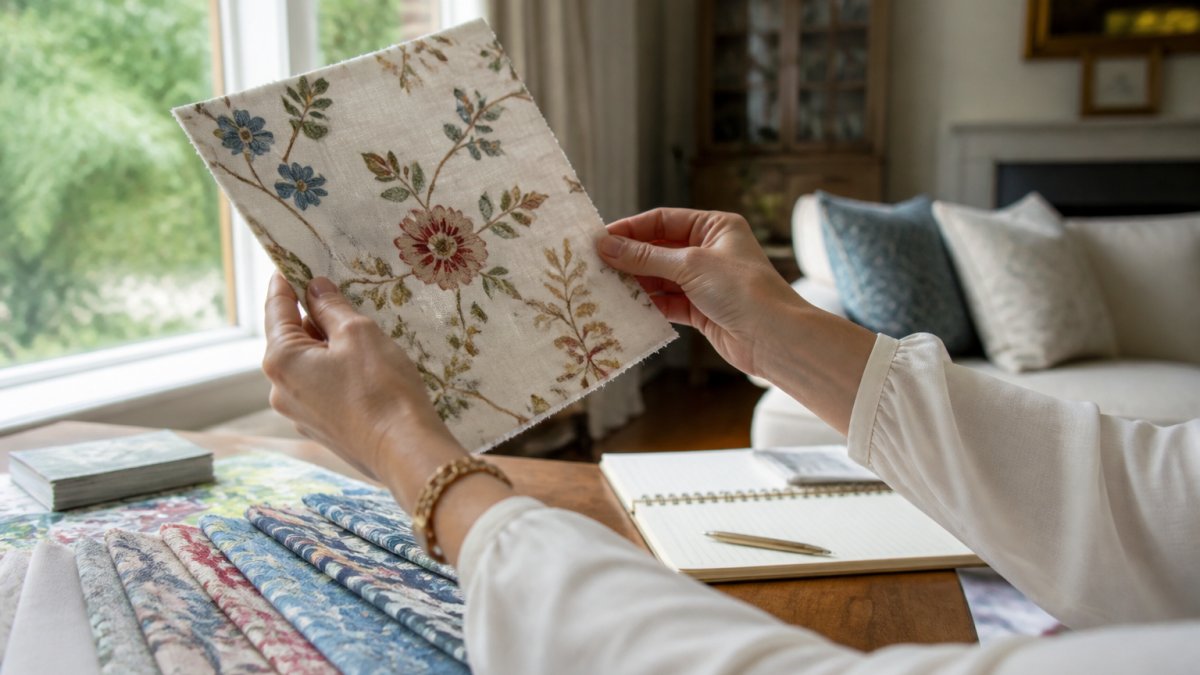
For artisanal cloth, the standard five checks, colour, pattern scale, weight and drape, stitch and finish, touch, are only the starting point.
Read the Construction, Not Just the Surface
Turn the swatch over. The back tells you more than the front.
- Weave structure. A plain weave looks the same front and back; a twill shows diagonal floats; a jacquard may show long floats across the back. Long floats on the reverse are normal in some embroideries.
- Selvedge. A hand-loomed selvedge is often narrower and less uniform than a milled one. Check for fraying or draw-in that would reduce usable width.
- Stitch density. In embroidery, look at the reverse: dense, even stitching with tidy starting and finishing points suggests careful work. Loose or chaotic backs may still be beautiful on the front but can be more fragile.
Judge Colour Variation Honestly
Hand-dyed, hand-printed, and hand-woven cloth varies across dye lots and within repeats. Decide whether the variation is acceptable before you order metres.
A practical test: lay two cuttings from the same fabric side by side. If the variation reads as depth and life, it will look good in the room; if it reads as mismatch, it will bother you every time.
Ask the supplier directly: "Is this colourway consistent across a production run, or should I expect variation?"
Translate the Swatch Into Custom Sample Specifications
If you need a custom dimension, print, dye, or repeat, the swatch is your reference, not the specification. It shows colour and hand, not a custom repeat, a different ground cloth, or a production-scale dye result.
When you request a custom sample, be explicit about what the sample can and cannot represent:
- Dimensions. Ask for a cutting that includes at least one full repeat in both directions if the repeat is central to the design.
- Colour matching. Provide a physical reference (paint chip, Pantone chip, or a previous cutting) and ask whether the maker can match it or only approximate it.
- Ground cloth changes. If you want the design on a different base cloth, ask whether a strike-off on that base is possible and what it costs.
Compare Like With Like
With several swatches, evaluate them in the same light, at the same time of day, against the same reference. Log your verdict on each with the date and light conditions.
When you've narrowed your choices, you can browse the fabrics to compare full colourways and specifications side by side.
Step 6: Place Your Fabric Order With Confidence
Once a swatch wins, order with the details in front of you. Confirm the fabric name, colourway, quantity, and minimum order, many decorative fabrics are sold by a two-yard minimum.
Confirm the delivery window once more, then confirm the order in writing, keeping your sample request and the supplier's reply on file.
A few habits make ordering safer:
- Order a little extra for pattern matching and future repairs
- Confirm the return policy before you commit
- Check who covers shipping if something needs to go back
When you're ready, you can place your fabric order with the specifications you've already confirmed.
Step 7: Follow Up Politely and Track Your Samples
If a week passes with no reply, send one short, friendly nudge referencing your original message and restating the key details.
Keep a simple log as samples arrive:
| What to Track | Why It Matters |
|---|---|
| Fabric name and colourway | Avoids ordering the wrong variant |
| Sample size received | Tells you if you need a larger cut |
| Date requested and received | Flags slow lead times early |
| Sample fee and postage | Reconciles against the final invoice |
| Your verdict | Speeds up the final choice |
That log turns a pile of swatches into a clear decision and protects you if a colour or quantity is questioned.
At Adams & Tharp, our collection of exclusive decorative fabrics is built for exactly this kind of considered selection, from embroidered florals to printed textiles.
Frequently Asked Questions
Are artisanal fabric samples free or do suppliers charge for them?
Most artisanal fabric suppliers charge a small fee per swatch or per sample set, and some credit that fee against a future order. Postage is often added separately, particularly for international delivery. Ask about the sample fee, whether it is refundable, and how shipping is calculated before you send your request. Adams & Tharp can confirm current sample terms when you contact them directly.
How long does it take to receive custom fabric samples?
Custom fabric sample lead time depends on whether the swatch is cut from existing stock or produced specifically for you. Stock swatches usually ship within days, while custom-dyed or custom-printed samples can take several weeks because they run alongside production. Some embroidered fabrics show a general delivery estimate of 18 to 19 weeks if not in stock, so plan your sample request well ahead of your installation date.
What should I check when evaluating a fabric swatch?
View the swatch in daylight, lamplight and evening light to see how the colour shifts. Check the repeat size against your window or upholstery dimensions, feel the weight and drape, and look closely at embroidery placement and colour variation. Ask about double rubs where durability matters, and confirm cleaning codes. Embroidered textiles are not guaranteed for precise colour matching, so compare several swatches before you commit.
Can I request a custom colour or pattern swatch?
Some makers accept custom sample requests for colourways or pattern adaptations, but production constraints apply. Minimum order quantities, repeat limitations and the number of colours a design can carry all affect what is possible. Include your specification, reference images and required quantity in your inquiry so the maker can confirm feasibility and quote a realistic lead time before sampling begins.
Choosing fabric for a serious interior project is a process, not a single click. The buyers who get the best results define the room first, ask precise questions, and judge every swatch in the light it will live in. Adams & Tharp curates exclusive decorative fabrics and traditional editions of English classics for exactly this level of care. Get started with Adams & Tharp and request your samples with confidence, knowing each choice is backed by a clear brief and a careful eye.
